You're Not in the Software Business
You're in the people business - your team are your moat.
Most tech executives think they’re in the software business. They’re not. They’re in the people business.
More specifically, they’re in the culture business - whether they realise it or not.
Software Is Not An Asset
Let’s run a simple thought experiment.
Imagine your company loses all of its software overnight. Source code, infrastructure, everything - gone. It would be painful, expensive, chaotic… but if you still had your team, you could rebuild. It might even come back faster and better the second time.
Now flip it - keep the software and lose all the people.
What you’re left with is a rapidly decaying asset. It might keep running for a while, but the moment something breaks or needs to change you’re stuck. No one fully understands it, no one feels accountable for it, and no one is in a position to safely evolve it. That “asset” will be come a liability within days, burning money in compute and storage as your paying users flee.
That’s the misunderstanding. Software feels like the asset because it’s visible, measurable, and shows up in all the places executives are trained to look. But it’s not.
It’s the byproduct of the thing that actually matters: a group of people who know how to build, maintain, and evolve it.
The Rowing Problem
This is where the rowing metaphor companies love comes in handy. “We all need to row in the same direction” sounds nice, and it’s true!
But the way many executives think and act is as if the boat is their asset. But the boat goes nowhere without rowers. And not just any rowers - good rowers. People who are capable, motivated, and willing to pull hard over a sustained period of time.
You don’t win because you have a slightly better boat - you win because you can consistently attract and retain better rowers than the company next to you.
That’s what culture actually controls. Culture is the system that determines who stays, who leaves, who joins, how expensive they are, and how they behave while they’re there. It’s downstream of everything: incentives, leadership behaviour, how decisions get made, what gets rewarded, what gets tolerated.
And you can’t fake it.
How Culture Fails
You can see the effects pretty clearly if you map people on a simple graph: competence on the x-axis, confidence on the y-axis.
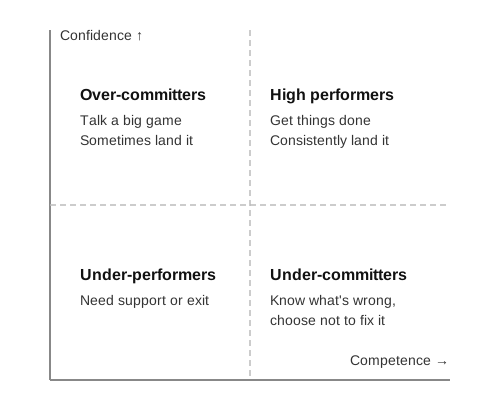
Top right: high performers - competent and confident.
Top left: over-committers - confident but not competent.
Bottom right: under-committers - competent but not confident.
Bottom left: under-performers.
When culture is working, people may move toward the top-right. They may not, of course, but at least they have a shot at it. But as culture degrades, people don’t move left, or down - they move out. They leave.
The people who leave first are the ones at the top of the confidence axis - cultural degradation begins at the top of our graph, and slowly makes its way down. The high performers and the over-committers are the first to go - the ones who know, or believe, they have options. They don’t stick around in environments where the cost of doing good work keeps going up.
What you’re left with, over time, is an irreparably toxic mix: people who can’t perform, and people who could, but have stopped trying.
That second group is a more insidious problem than many realise, because they are too busy focussed on the under performers. But the under committers can cause problems even in a good environment. They are competent enough to understand exactly what’s wrong, and are often vocal in this, but they’ve disengaged from trying to fix it. That attitude spreads.
This is how organisations hollow out. Not with a dramatic collapse, but with a slow shift in the average level of energy, ownership, and ambition.
From the outside, things can look fine for a while. Tickets are still getting closed. Roadmaps are still being updated. But the underlying capability is eroding, and eventually it shows up everywhere: slower delivery, lower quality, more coordination overhead, more process to compensate for the lack of trust.
At that point, the instinct is to add even more control. More oversight, more approvals, more pressure to perform. But this is exactly how you finish things off.
The problem was never that people didn’t know what to do, it’s that the environment stopped being one where good people could - or wanted to - do it.
When environments become hostile or limiting, the people with the most options leave. What remains isn’t stable - it’s a system with reduced capacity to adapt, improve, and compete over time.
The Real Business of Software
The real business of software is building a strong culture, that attracts great talent, that further strengthens and perpetuates that culture.
Cultural norms must be established, owned and relentlessly defended by everyone. Even people who would otherwise be high performers but refuse to engage with your culture require immediate intervention. If they do not improve promptly, they should be exited just as promptly.
If you’re an executive of a tech company and think your product or your software is your moat, then you don’t understand the business you’re in. You’re in the people business - your team are your moat.
If you fail to understand this then you will find yourself shouting louder and louder at a boat that is fast emptying of rowers willing and able to pull the oars, and your competition will begin to row right by you.
If you’re an executive in a tech company, your job is to build and maintain an environment where capable people can do good work, together, and want to keep doing it. Because in the long run, that’s the only thing that compounds.
Everything else - the code, the systems, even the strategy - is downstream of that.
Link copied!